
It All Began With Drip-Drip Question Answer Lesson 1 Class 6 English wbbse | ষষ্ঠ শ্রেণির ইংরেজি লেশন ১ প্রশ্নোত্তর
📌ষষ্ঠ শ্রেণি ইউনিট টেস্ট প্রশ্নপত্র Click Here
📌ষষ্ঠ শ্রেণি ইংরেজি প্রশ্নোত্তর Click Here
It All Began With Drip–Drip
(ইট অর বিগান উইথ্ ড্রিপ ড্রিপ)
সবকিছুই শুরু হয়েছিল ফোঁটা ফোঁটা জল পড়া দিয়ে।
—Alka Shankar and Sharleen Mukundan (অলকা শংকর অ্যান্ড শার্লিন মুকুন্দন)
Let’s start:
ACTIVITY 1
Tick [✓] the correct alternative: (সঠিক বিকল্পটির পাশে টিক (✓) চিহ্ন দাও)।
(a) The tiger took shelter near the house of
(i) an old woman
(ii) an old man✓
(iii) a neighbour.
[বাঘটি আশ্রয় নিয়েছিল (i) এক বৃদ্ধার (ii) এক বৃদ্ধের (iii) এক প্রতিবেশীর বাড়ির পাশে।]
(b) The old woman was
(i) soft-spoken
(ii) ill-tempered✓
(iii) shy
[বৃদ্ধ মহিলা ছিলেন (i) মৃদুভাষী (ii) বদরাগি (iii) লাজুক]
(c) The tiger thought drip-drip was
(i) the constant falling of rain
(ii) the name of a man
(iii) a creature✓
[বাঘটি ভেবেছিল টিপটিপ হলো (i) একটানা বৃষ্টি পড়া (ii) একটি লোকের নাম (iii) একটি জীব।]
(d) Bholenath was a
(i) farmer
(ii) weaver
(iii) potter✓
[ভোলেনাথ ছিল একজন (i) চাষি (ii) তাঁতি (iii) কুমোর]
ACTIVITY 2
Rearrange the following sentences in the correct order and put the numbers in the given boxes. One is done for you : (নিচের বাক্যগুলিকে সঠিক ক্রম অনুসারে সাজাও এবং প্রদত্ত বাক্সে সঠিক নম্বরটি লেখো। একটি তোমার জন্য করে দেওয়া আছে)।
(1) She pushed her bed around the room to keep it dry.
(সে শুকনো রাখার জন্য খাটটিকে ঘরের চারিদিকে ঠেলতে লাগলো)
(2) The tiger took shelter outside an old woman’s hut.
(বাঘটি এক বৃদ্ধ মহিলার কুটিরের বাইরে আশ্রয় নিয়েছিল)
(3) Bholenath was looking for his donkey.
(ভোলেনাথ তার গাধার খোঁজ করছিল)
(4) A tiger was caught in a storm. 1
(একটি বাঘ ঝড়ের মধ্যে আটকে পড়েছিল)
(5) Bholenath saw an animal huddled against the wall of the woman’s hut.
ভোলেনাথ একটি প্রাণীকে এক মহিলার কুঁড়েঘরের দেয়ালের পাশে গুটিসুটি মেরে বসে থাকতে দেখল)
(6) The old woman was ill- tempered that night.
(বৃদ্ধ মহিলাটি ওই রাত্রে বদরাগি কি ছিলেন)
Ans :
(1) She pushed her bed around the room to keep it dry. [3]
(2) The tiger took shelter outside an old woman’s hut. [4]
(3) Bholenath was looking for his donkey. [5]
(4) A tiger was caught in a storm. [1]
(5) Bholenath saw an animal huddled against the wall of the woman’s hut. [6]
(6) The old woman was ill- tempered that night. [2]
ACTIVITY 4
Complete the following sentences with information from the text : (পাঠ্যাংশ থেকে তথ্য নিয়ে নিচের বাক্যগুলিকে সম্পূর্ণ করো)।
(a) The tiger was frightened because _______________________. (বাঘটি ভয় পেয়েছিল কারণ …)
Ans: he thought Bholanath must be the terrible drip-drip. (সে লোকটিকে ভয়ংকর টিপটিপ ভেবেছিল)।
(b) Bholenath’s wife screamed in fear when ______________________. (ভোলেনাথের স্ত্রী ভয়ে চিৎকার করে উঠলো তখন ….)
Ans: she discovered the tiger tied to the tree. (সে দেখল বাঘটি গাছের সঙ্গে বাঁধা)।
(c) Disturbed and confused by the people, the tiger _______________
_____________________. (লোকের ভিড়ে বিরক্ত ও হতভম্ব হয়ে গিয়ে বাঘটি …)
Ans: had chewed through the rope. (দড়ি চিবিয়ে কেটে ফেললো)।
(d) Bholenath announced proudly that _____________________________. (ভোলেনাথ গর্ব ঘরে ঘোষণা করলো যে …)
Ans: he had captured the tiger last night. (সে গতরাত্রে বাঘটিকে ধরেছিল)।
ACTIVITY 5
Answer the following questions: (নিচের প্রশ্নগুলির উত্তর দাও)।
(a) Why did Bholenath bring the tiger home ? (ভোলেনাথ কেন বাক্তিকে বাড়ি নিয়ে এসেছিল ?)
Ans: Bholenath mistakenly thought the tiger to be his lazy donkey. (ভোলেনাথ বাঘটিকে বাড়ি এনেছিল কারণ অন্ধকারে সে বাঘটিকে তার অলস গাধা বলে ভেবেছিল)।
(b) What made the neighbours come running out of their huts ? (প্রতিবেশীরা কেন ঘর থেকে দৌড়ে বেড়িয়ে এসেছিল ?)
Ans: As Bholenath’s wife screamed in fear discovering a tiger, the neighbours came running out of their huts. (যেহেতু বাঘটিকে কে দেখে ভোলেনাথের স্ত্রী ভয়ে চিৎকার করেছিল তাই প্রতিবেশীরা দৌড়ে ঘর থেকে বেরিয়ে এসেছিল)।
(c) Why were the villagers relieved ? (গ্রামবাসীরা স্বস্তি পেয়েছিল কেন ?)
Ans: The he villagers were relieved because the tiger ran away to the jungle. (গ্রামবাসীরা স্বস্তি পেয়েছিল কারণ বাঘটি দৌড়ে জঙ্গলে পালিয়ে গিয়েছিল)।
(d) How did the king reward Bholenath for his bravery ? (রাজা কিভাবে ভোলেনাথকে তার সাহসিকতার জন্য পুরস্কৃত করেছিলেন ?)
Ans: The king rewarded Bholenath by making him the Commander-in-chief of the king’s army. He was also given a huge house to live in. (রাজা ভোলানাথকে রাজ্য সৈন্যবাহিনীর প্রধান সেনাপতি পদে নিযুক্ত করেছিলেন। বাস করার জন্য তাকে একটি বড় বাড়িও দেওয়া হয়েছিল।
ACTIVITY 6
Write ‘T’ for true and ‘F’ for false statements in the given boxes. Give supporting statements for each of your answers: (নিচের দেওয়া বাক্স গুলিতে ঠিক হলে ‘T’ এবং ভুল হলে ‘F’ লেখো, প্রত্যেকটি উত্তরের সমর্থনে একটি বাক্য লেখো)
(a) Bholenath did not know how to ride a horse. [ T ]
(ভোলেনাথ জানত না কীভাবে ঘোড়ায় চড়তে হয়।)
Supporting Statement: “I don’t even know how to ride a horse”, he told his wife helplessly.
(b) The king sent Bholenath a magnificent elephant. [ F ]
(রাজা ভোলানাথ কে একটি চমৎকার হাতি পাঠিয়ে ছিলেন।)
Supporting Statement: the king sent Bholenath a magnificent stallion.
(c) The enemy soldiers were happy to see Bholenath.[ F ]
(শত্রুসৈন্যরা ভোলেনাথকে দেখে খুশি হলো।)
Supporting Statement: The enemy soldiers were astonished to see
(d) Bholenath defeated the enemy soldiers single-handedly. [ T ]
(ভোলেনাথ একা হাতে শত্রু সৈন্যদের হারিয়ে ছিল।)
Supporting Statement: he had defended his state all by himself
ACTIVITY 7
Answer the following questions in complete sentences: (নিচের প্রশ্নগুলির পূর্ণ বাক্যে উত্তর দাও)
(a) Why was Bholenath full of despair ? (ভোলেনাথ কেন সম্পূর্ণ হতাশ হয়ে পড়েছিল ?)
Ans: Bholenath was full of despair because he did not know how to ride a horse.
(ভোলেনাথ সম্পূর্ণ হতাশ হয়ে পড়েছিল কারণ ঘোড়ায় চড়তে জানতো না।)
(b) How did his wife help him to overcome his trouble ? (সমস্যার সমাধানে তার স্ত্রী কিভাবে তাকে সাহায্য করেছিল ?)
Ans: Bholanath’s wife securely tied him to the stallion with a rope to overcome his trouble. (সমস্যার সমাধানে তার স্ত্রী ভোলেনাথকে ঘোড়ার সাথে শক্ত করে বেঁধে দিয়েছিল।)
(c) What made the enemy soldiers greatly scared ? (শত্রু সৈন্যরা ভীষণ ভয় পেয়েছিল কেন ?)
Ans: The enemy soldiers were astonished and scared to see a wild-looking man tied to a fierce stallion, waving branches excitedly.
(শত্রুসৈন্যরা ভয় পেল যখন ভয়ঙ্কর এক ঘোড়ার সঙ্গে বাঁধা একজন লোককে উত্তেজিতভাবে গাছের ডাল করাতে দেখল।)
(d) Do you think Bholenath could truly be called a legendary character ? Give reasons for your answer. (তুমি কি মনে করো ভোলেনাথ সত্যি কিংবদন্তি চরিত্র ? তোমার উত্তরের সপক্ষে যুক্তি দাও।)
Ans: No, I don’t think Bholenath could truly be called a legendary character.
Because he defeated his enemy soldiers with all his mistakes and confusion he had made.
না, ভোলেনাথকে সত্যিকার অর্থে কিংবদন্তি চরিত্র বলা যেতে পারে বলে আমার মনে হয় না।
কারণ সে তার শত্রু সৈন্যদের তার সমস্ত ভুল এবং বিভ্রান্তি দিয়ে পরাজিত করেছিল।
ACTIVITY 8 (a)
Read the following sentences. Underline the the Nouns which indicate either a state of being or a quality of mind: (নিচের বাক্যগুলি পড়ো। কোনো অবস্থা বা মনের ভাব নির্দেশ করে এমন নাউন গুলির নিচে দাগ দাও)
(i) The king is known for his kindness.
(রাজা তাঁর দয়ার জন্য পরিচিত)
Noun : kindness
(ii) The beauty of the flower attracted me. (ফুলটির সৌন্দর্য আমাকে আকৃষ্ট করেছিল)
Noun : beauty
(iii) Childhood is fun.
(শৈশবকাল হলো মজার।)
Noun : Childhood
(iv) India attained freedom in 1947.
(ভারত স্বাধীনতা লাভ করেছিল ১৯৪৭ সালে)
Noun : freedom
Let’s Learn : এসো শিখি।
The words you have underlined in Activity (8a) are Abstract Nouns. Abstract nouns always indicate a state of being or a quality of mind.
[Activity (8a)-তে তোমরা যে শব্দগুলির নীচে দাগ দিলে সেগুলি হল Abstract Noun. Abstract Noun সবসময় কোনো অবস্থা বা মনের ভাব বোঝায়।]
Note that Abstract nouns are usually formed from… [লক্ষ করো, Abstract Noun সাধারণত গঠিত হয়…]
(i) Adjectives e.g. ‘bravery’ from ‘brave’, ‘kindness’ from ‘kind’ etc.
[Adjective থেকে যেমন-‘সাহস’ থেকে ‘সাহসিকতা’, ‘দয়ালু’ থেকে ‘দয়া’ প্রভৃতি।]
(ii) Verbs e.g. ‘death’ from ‘die’, ‘freedom’ from ‘free’.
[Verb থেকে যেমন—’মারা যাওয়া’ থেকে ‘মৃত্যু’, ‘স্বাধীন হওয়া’ থেকে ‘স্বাধীনতা’।]
(iii) Common nouns e.g. ‘childhood’ from ‘child’, ‘heroism’ from ‘hero’ etc.
[Common noun থেকে যেমন-‘শিশু’ থেকে ‘শৈশব’, ‘নায়ক’ থেকে ‘নায়কোচিত’ ইত্যাদি।]
ACTIVITY 8 (b)
Form abstract nouns from the following words: (নিচের শব্দ গুলি থেকে অ্যাবস্ট্রাক্ট নাউন তৈরি করো)
(i) dark (অন্ধকার) : _________
Ans: darkness (আঁধার)
(ii) adult (প্রাপ্তবয়স্ক) : _________
Ans: adulthood (প্রাপ্তবয়স্কতা)
(iii) amaze (বিস্ময়ে অভিভূত) : _______
Ans: amazement (বিস্ময়ে)
(iv) disturb (বিরক্ত) : __________
Ans: disturbance (বিরক্তি)
(v) confuse (বিভ্রান্ত) : __________
Ans: confusion(বিভ্রান্তি)
(vi) sweet (মিষ্টি) : __________
Ans: sweetness (মিষ্টতা)
ACTIVITY 8 (c)
Underline the words that indicate a group of people, animals or things taken as a whole : ( লোক, প্রাণী বা বস্তুর একসঙ্গে অনেককে বোঝায় এমন শব্দগুলির নিচে দাগ দাও)
(i) I saw a crowd in front of the shop.
(দোকানের সামনে আমি ভিড় দেখেছিলাম)
Ans: crowd
(ii) A herd of cattle is passing by.
(একদল গবাদি পশু যাচ্ছে)
Ans: herd
(iii) Our school cricket team has won.
(আমাদের স্কুলের ক্রিকেট দল জিতেছে)
Ans: team
(iv) A bunch of flowers was kept in the vase.
(ফুলদানিতে একগুচ্ছ ফুল রাখা ছিল)
Ans: bunch
Let’s Learn: (চলো শিখি)
The words you have underlined in Activity 8(c) are called Collective Nouns. Collective Nouns indicate a group of people, animals or things taken as a whole. Collective Nouns always take a singular verb when it is used in Present tense.
Activity 8(c)-তে যে শব্দগুলির নীচে তোমরা দাগ দিলে সেগুলিকে বলে Collective Noun. Collective Noun বলতে লোক, জন্তু অথবা বস্তুর একসঙ্গে অনেককে বোঝায়। Collective Noun যখন Present tense-এ ব্যবহৃত হয় তখন একবচনের verb ব্যবহার করা হয়।
Let’s Do : চলো করি।
ACTIVITY 8 (d)
Fill in the blanks with the appropriate collective nouns given in the Help Box. One is done for you:
(i) A _______ of policemen marched by.
(_________ পুলিশ মার্চ করে যাচ্ছিল)
Ans : posse (একদল)
(ii) I bought a _________ of grapes from the market.
(আমি বাজার থেকে ________ আঙ্গুর কিনে এনেছিলাম)
Ans: bunch (এক থোকা)
(iii) A __________ of sheep was grazing in the field.
(মাঠে _________ ভেড়া চরছিল)
Ans: flock (একপাল)
(iv) I saw a ________ of bees buzzing around.
(আমি ________ মৌমাছি ভনভন করতে দেখলাম।)
Ans : swarm (এক ঝাঁক)
(v) The ________ is very noisy.
( ________ বড় কোলাহল মুখর)
Ans : class (শ্রেণি)
| [Help Box: flock, posse, swarm, bunch, class] |
Let’s Learn : এসো শিখি।
Read the following sentences: [নীচের বাক্যগুলি পড়ো:]
1. The wall shook. [দেয়ালটি কেঁপে উঠল।]
2. The horse galloped off wildly. [ঘোড়াটি উন্মত্তের মতো নে দৌড়াল।]
3. Rainwater was leaking through the roof. [বৃষ্টির জল ছাদ চুঁইয়ে পড়ছিল।]
4. Bholenath hung desperately to its mane. [ভোলেনাথ সেটির কেশর ধরে মরিয়া হয়ে ঝুলেছিল।]
In sentences 1 and 2, the blue coloured words ‘wall’ and ‘horse’ are names of an object and a living being which can be counted. But in sentence 3 and 4, the red coloured words ‘rainwater’ and ‘mane’ cannot be counted.
১ম এবং ২য় বাক্যে নীল রঙের শব্দ ‘দেয়াল’ এবং ‘ঘোড়া’ গুণতে পারা যায় এমন কোনো বস্তুর নাম এবং জীবন্ত প্রাণীর নাম। কিন্তু ৩ ও ৪ নং বাক্যে লাল রঙের শব্দ ‘বৃষ্টির জল’ এবং ‘কেশর’ গোনা যায় না।
ACTIVITY 8 (e)
Underline the words in the following sentences that can be counted. Circle the the words that cannot be counted: (নিচের বাক্যগুলিতে যেগুলি গোনা যায় সেই শব্দ গুলির নিচে দাগ দাও। যেগুলি গোনা যায় না সেই শব্দগুলিতে গোল দাগ দাও।)
(i) I am reading a book.
Ans: Counted— book.
Cannot be Counted— (নেই)
(ii) Iron is a useful metal.
Ans: Counted— (নেই)
Cannot be Counted— Iron
(iii) Snowy is his pet dog.
Ans: Counted— dog
Cannot be Counted— (নেই)
(iv) She has long hair.
Ans: Counted— (নেই)
Cannot be Counted— hair
Let’s Learn : চলো শিখি।
The words that you have underlined in Activity 8 (e) are Countable Nouns. Countable Nouns have plural forms.
[Activity 8(e)-তে যে শব্দগুলির নীচে দাগ দিয়েছ সেগুলি হল Countable Noun। এগুলির বহুবচন হয়।]
The words you have circled in Activity 8(e) are Uncountable Nouns. Uncountable Nouns do not have plural forms.
[Activity 8(e)-তে যে শব্দগুলিকে গোল দাগ দিয়েছ তা সেগুলি হল Uncountable Noun. Uncountable Noun-এর বহুবচন হয় না।]
ACTIVITY 8 (f)
Read the sentences carefully and put the underlined words in the correct columns: [নিচের বাক্যগুলিকে যত্ন সহকারে পড়ো এবং নিচে দাগ দেওয়া শব্দগুলিকে সঠিক column (ঘরে) রাখো]
(i) Milk is good for health.
(ii) The door is closed.
(iii) I bought a kilo of sugar from the market.
(iv) Children play with toys.
Ans:
| Countable Nouns | Uncountable Nouns |
| door, market, children, toys | milk, sugar |
ACTIVITY (9)
Find words from the text nearest in meaning to the words given below: [নীচে দেওয়া শব্দগুলির কাছাকাছি অর্থের শব্দ পাঠ্যাংশ থেকে খুঁজে বের করো :
(a) kingly – royal (রাজকীয়)
(b) sorrow – sadness (দুঃখ, হতাশা)
(c) surprised – astonished (অবাক হয়েছিল)
(d) afraid – scared (ভীত, সন্ত্রস্ত)
Let’s Do :
ACTIVITY (10a)
Imagine you are caught in a storm while returning home one night. Write a short paragraph in about sixty words describing your experience. Use the following hints: [মনে করো এক রাতে বাড়ি ফেরার পথে তুমি ঝড়ের মধ্যে পড়েছ। কমবেশি ষাটটি শব্দে তোমার অভিজ্ঞতার বর্ণনা করে একটি সংক্ষিপ্ত অনুচ্ছেদ লেখো। নীচের সংকেতগুলি ব্যবহার করো:]
Hints: returning from aunt’s place – sky darkened – wild wind – rain – no one around – how you reached home [কাকিমার বাড়ি থেকে ফেরার পথে – আকাশ অন্ধকার – ঝোড়ো বাতাস – বৃষ্টি – কেউ কোথাও নেই – কীভাবে তুমি বাড়ি পৌঁছোলে]
Ans.
Caught in a Storm
I was coming home one day from my aunt’s house. My home was quite a bit away. Suddenly, clouds began to cover the sky. Since no one was with me, I felt afraid. Next, rain and a ferocious wind arrived. I began to flee, terrified. I exhaled with relief as I eventually made it home. I had never experienced an encounter like this in my life before.
ঝড়ে আটকা পড়ে
একদিন আমি আমার কাকিমার বাড়ি থেকে ফিরছিলাম। এটা বাড়ি থেকে অনেক দূরে। হঠাৎ করে আকাশ কালো মেঘে ছেয়ে গেল। আমি প্রচন্ড ভয় পেয়ে গিয়েছিলাম কারণ কেউ আমার সঙ্গে ছিল না। এবার ঝোড়ো বাতাসের সঙ্গে বৃষ্টি আরম্ভ হল। আমি প্রচণ্ড ভয়ে দৌড়োতে শুরু করলাম। শেষে যখন বাড়ি পৌঁছোলাম, আমি স্বস্তির নিঃশ্বাস ফেললাম। আমি সারাজীবনে কখনও এরকম অভিজ্ঞতার সম্মুখীন হইনি।
ACTIVITY (10b)
Study the family chart given below: [নীচের বংশ তালিকা লক্ষ করো:]
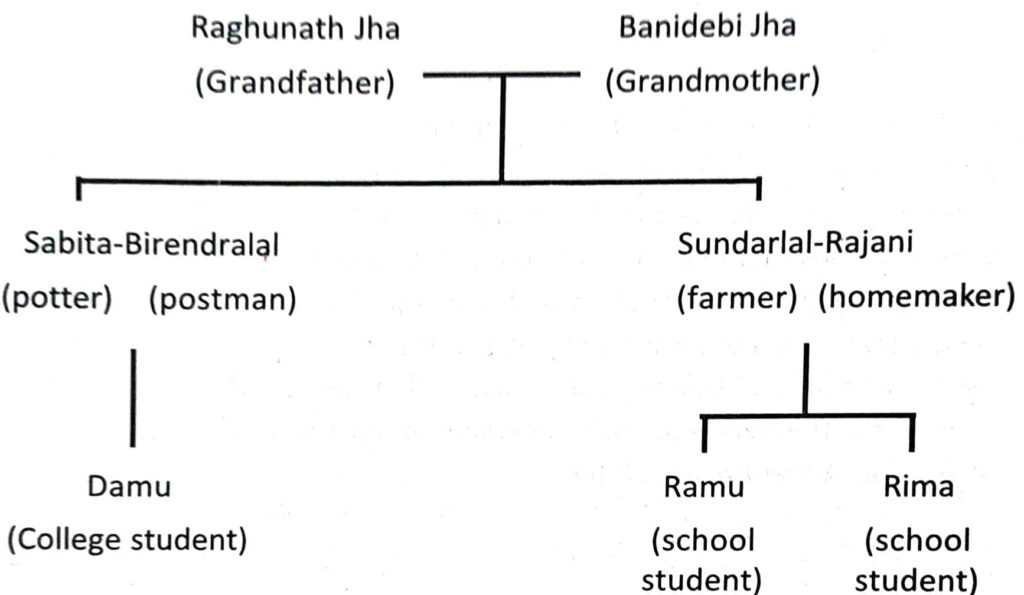
Suppose you are Rima. Your grandfather is Raghunath Jha. Write
a short paragraph in about six sentences about your family. [মনে করো, তুমি রিমা। তোমার দাদু হলেন রঘুনাথ ঝা। তোমার পরিবার সম্পর্কে ছ-টি বাক্যে একটি সংক্ষিপ্ত অনুচ্ছেদ লেখো।]
Ans. I am Rima. My grandfather is Raghunath Jha and grandmother, Banidebi Jha. My parents are Sundarlal Jha and Rajani Jha. Ramu is my brother. We are students and we go to school. My aunt, Sabita is a potter and her husband Birendralal is a postman. They have only one son, Damu, who is at present a college student.
[আমি রিমা। আমার দাদু হলেন রঘুনাথ ঝা এবং ঠাকুমা বানীদেবী ঝা। আমার বাবা-মা হলেন সুন্দরলাল ঝা এবং রজনী ঝা। রামু হল আমার ভাই। আমরা হলাম ছাত্রছাত্রী এবং স্কুলে যাই। আমার পিসিমা, সবিতা হলেন একজন কুমোর এবং তাঁর স্বামী বীরেন্দ্রলাল হলেন একজন পিয়োন। তাঁদের একমাত্র ছেলে দামু, যে বর্তমানে একজন কলেজ ছাত্র।]
📌 আরো দেখুনঃ
📌ষষ্ঠ শ্রেণি ইউনিট টেস্ট প্রশ্নপত্র Click Here
📌ষষ্ঠ শ্রেণি বাংলা প্রশ্নোত্তর Click Here
📌ষষ্ঠ শ্রেণি ইংরেজি প্রশ্নোত্তর Click Here
📌ষষ্ঠ শ্রেণি ইতিহাস প্রশ্নোত্তর Click Here
📌ষষ্ঠ শ্রেণি ভূগোল প্রশ্নোত্তর Click Here
📌ষষ্ঠ শ্রেণি গণিত প্রশ্নোত্তর Click Here
📌ষষ্ঠ শ্রেণি বিজ্ঞান প্রশ্নোত্তর Click Here
The best